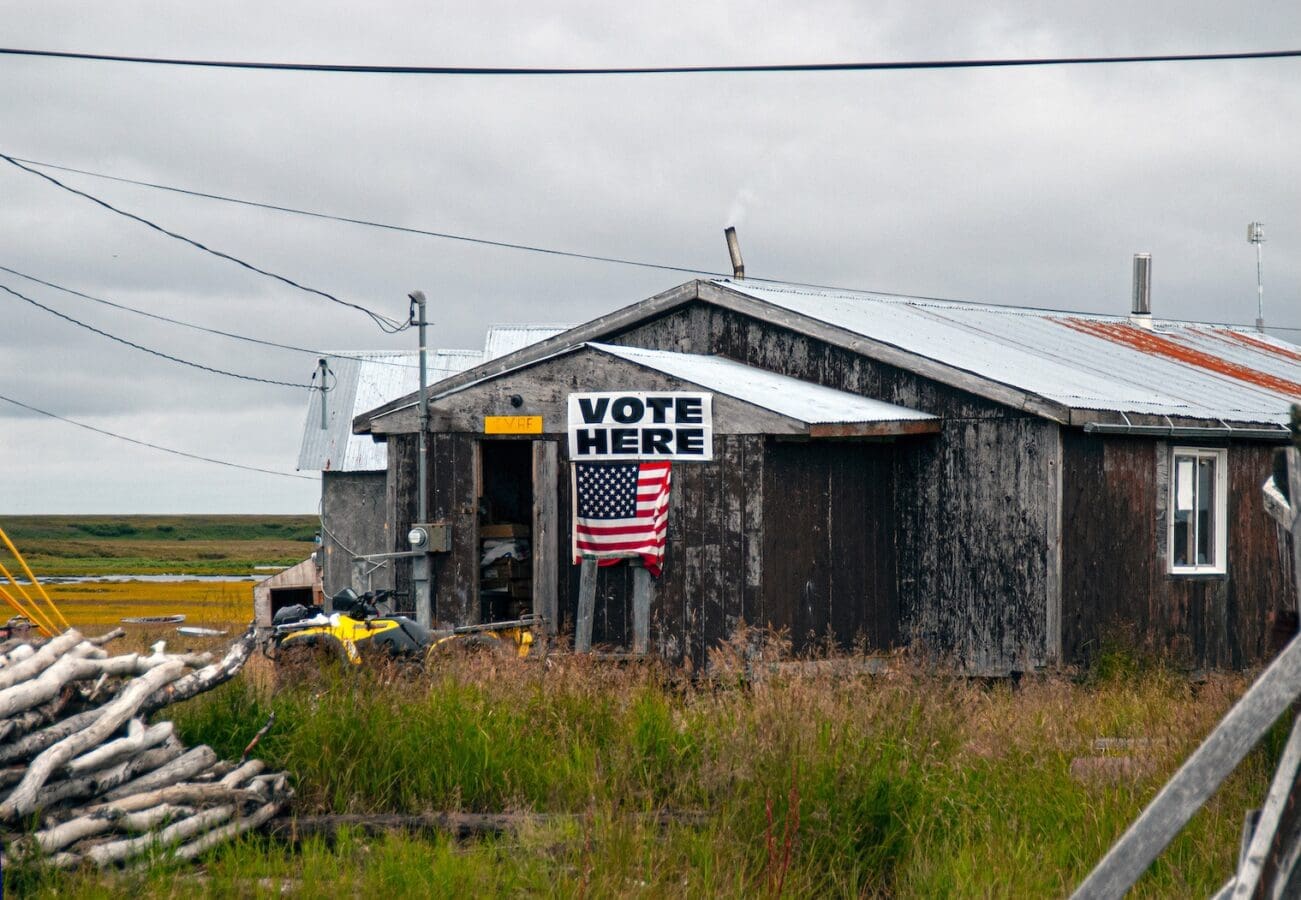
The mid-term election season is in its final weeks, and this year the results of Alaska’s elections carry particular significance, both for the future direction of Alaska and for the balance of power in Congress. Alaska has a notorious independent streak, with 63% of the electorate registered nonpartisan or undeclared, and election innovations such as open primaries and ranked-choice voting generating multi-partisan majority coalitions of Independents, Republicans, and Democrats in both the Alaska State Senate and House. Alaska’s Legislature is the only legislature in the nation with this type of leadership.
It is important to understand how Alaska’s election system works. In the open primary, all candidates appear on the same ballot, and voters can choose their top choice regardless of party affiliation. The top four vote-getters in each race advance to the general election, where voters can, if they choose, rank those candidates from their top choice to their bottom choice. If no candidate wins a majority of first-choice votes, the last-place candidate is eliminated, and those votes go to each voter’s next choice, repeating until one candidate has a simple majority of the votes.
Voter turnout was 27.7% of the electorate in the August 18th primary. This turnout, one of the highest primary turnouts since Alaska tied automatic voter registration to the annual Permanent Fund Dividend application a decade ago, was up from 18% in the 2024 primary. Post-primary, here’s what will be on Alaska’s general election ballot on November 3rd:
US Senate Race
This is the race with the most national prominence, as the balance of power in the U.S. Senate will be determined by just a handful of races nationwide. It pits Mary Peltola (D), a former Alaska state legislator and former Alaska member of the U.S. House of Representatives (2022-2024), against two-term incumbent Dan Sullivan (R). In the primary, Peltola received 49.5% of the vote while Sullivan received 41.4%. In 2024, Peltola led in a similar manner over Nick Begich in the primary but ultimately lost in the general election, as the electorate can change significantly from primary to general. Polls currently have Peltola ahead by one point. Fun fact about this race: two of the four final candidates are named Dan Sullivan (the incumbent and a retired schoolteacher from Petersburg). Gerald Heikes (R) is the fourth candidate.
US House Race
As with the Senate race, Alaska’s lone seat in the US House of Representatives could also determine who holds power in this chamber, though the current national landscape suggests the Democrats may win back control of the House by several seats. Incumbent Representative Nick Begich (R) received 44.6% of the vote while Bill Hill (I), a Bristol Bay fisherman and teacher, received 32.5%. The third candidate to receive the most votes at 8% was Matt Schultz (D), who dropped out of the race just before the primary but remained on the ballot. That means Begich and Hill are joined in the top four by Eric Hafner (D) and Jim McDermott (Libertarian). The most recent polling shows this as a very close race with Begich in the lead by one point.
Governor’s Race
The first open governor’s race without an incumbent running since 2002 featured 17 candidates on the ballot, including 12 Republicans, 3 nonpartisans, and 2 Democrats. Jonathan Kreiss-Tomkins (D), a five-term state representative from Sitka, received 22.5% of the vote, leading all others. Tom Begich (D), a former two-term state senator from Anchorage, finished second with 20.8% of the vote and subsequently dropped out, endorsing Kreiss-Tomkins. Advancing with Kreiss-Tomkins are Bernadette Wilson (R), an Anchorage business owner and talk radio host who received 10%, Dave Bronson (R), a former Anchorage mayor who received 8.1%, and Treg Taylor (R), a former Alaska attorney general who was briefly disqualified as a candidate for improper financial disclosure and then reinstated to the ballot, received 7.25%. Alaska Venture Fund’s New Energy Alaska campaign co-hosted a Gubernatorial Energy Forum with all four of the candidates on September 21st. It can be watched here.
Alaska Legislature
All 40 state House and 10 of 20 state Senate seats will be on the ballot in November and will determine whether multi-partisan governing coalitions continue to be formed in each body. Primary results generally favor incumbents.
Ballot Measures
Passing in the primary with 72.2% of the vote was a ballot measure that sets limits on political contributions from individuals, political parties, and other groups. It will go into effect during the next election cycle and will not affect the November 2026 elections. An effort to repeal Alaska’s voting reforms that include open primaries, ranked choice voting, and dark money disclosures will be on the general election ballot (Prop 2). Polling currently shows this to be a very close race. To help Alaskan voters make their own decision, AVF sponsored Commonwealth North’s Prop 2 Forum on September 28th, which featured representatives of both sides of the issue making their case. It can be watched here.
As with the rest of the nation, Alaska’s general election will be on Tuesday, November 3rd. Because of how votes are cast and counted in Alaska, final election results will not be available for several weeks after the election. It takes time for votes to arrive from the hundreds of remote and rural communities accessible only by plane or boat. Counting absentee and early ballots also takes time. If races are close, we may not know the results until the state certifies the election on November 25th.
A robust non-partisan 501(c)(3) effort has been built to protect free and fair elections by a number of peer organizations, such as the Alaska Voter Hub. That work has taken on greater urgency in recent months amid concerns about the Alaska Division of Elections, including its actions to remove voters from the rolls, disqualify candidates, and allow candidates to run after previously disqualifying them. The Anchorage Daily News Editorial Board has written two editorials about this since August. The first questioned whether the Division of Elections is being weaponized for political purposes and the second highlighted flagrant deficiencies in its conduct. There are still 501(c)(3) funding opportunities in 2026 election protections efforts. Please contact Matt Rafferty at matt@alaskaventure.org for more information.